
By
Amanda Lane Stansberry
Updated:
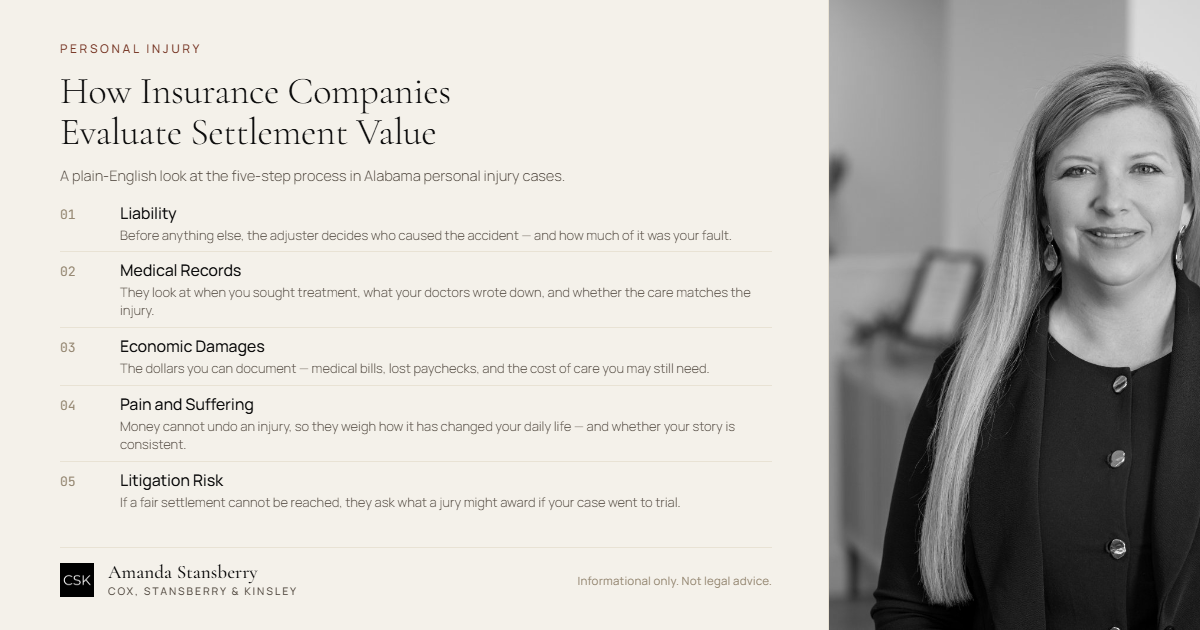
Insurance companies value Alabama personal injury claims through a five-step process: confirming liability under the state’s strict contributory negligence rule, reviewing medical records, calculating economic damages, evaluating pain and suffering, and weighing litigation risk. The final settlement offer reflects documentation quality, attorney involvement, and policy limits as much as any formula.
Listen to this article: How Insurance Companies Evaluate Settlement Value in Alabama Personal Injury Cases — a narrated guide covering a five-step process for helping to determine settlement value. 11 minutes.
After an accident, one of the first questions people ask is, “How much is my case worth?”
The answer often surprises people, because it depends as much on what is happening on the other side of the negotiation as it does on the injury itself.
Insurance companies do not guess or use a simple formula to decide what your case is worth. They do not just multiply your medical bills or use a chart for pain and suffering. Instead, they follow a step-by-step process that looks at fault, your paperwork, your credibility, the other driver, and the risks involved. This process shapes every offer they make.
Knowing how insurance companies really look at claims can help you make better choices from the start. It lets you spot problems early, understand what an offer really means, and avoid mistakes that can cost you later.
Here is how that process usually works in Alabama.
How Do Insurance Companies Calculate Settlement Value in Alabama?
Insurance companies in Alabama evaluate settlement value in five steps:
Liability — establishing fault, which under Alabama’s contributory negligence rule can make or break a claim
Medical review — examining records for prompt treatment, gaps in care, and objective findings
Economic damages — medical expenses, lost wages, and documented future needs
Pain and suffering — the duration, permanency, and credibility of the injury’s impact on daily life
Litigation risk — what a jury might do if the case goes to trial
The sections below walk through each step in detail.
Step One: Liability Comes First
Before an insurance company evaluates damages, it evaluates fault.
This matters even more in Alabama. Alabama follows a strict contributory negligence rule: if you are found even a little bit at fault, you may not be able to recover anything. Because of this rule, insurance adjusters look hard for any sign that you might share some responsibility.
Early in a case, adjusters typically ask:
- Is liability clear?
- Is there any evidence of shared fault?
- Are there conflicting witness statements?
- How does the accident report assign fault?
- Are there recorded statements that suggest partial responsibility?
If fault is clear, settlement talks can move ahead. If there is any question about who was at fault, even a small one, the value of your case can drop a lot, no matter how badly you were hurt.
In Alabama, the strength of your case on fault is often the most important part of what your claim is worth. Early mistakes here are hard to fix later.
Step Two: Reviewing the Medical Picture
Once fault is sorted out, the insurance company looks closely at your medical records. They pay more attention to the details than most people expect.
Insurance companies do not simply tally bills. They review the records themselves, sometimes line by line. They are looking at:
- Whether treatment began promptly after the accident
- Gaps in treatment
- Pre-existing conditions
- Objective findings, such as imaging results
- Whether treatment is consistent with the reported mechanism of injury
If you waited to get treatment, have gaps in your care, or had similar injuries before, the insurance company may use that to argue your case is worth less. The same goes for cases where your symptoms are real but the tests do not show much.
Insurance companies often sort injuries into categories based on how serious they are and how well they are documented. Two people with the same injury can end up with very different offers if one has better paperwork than the other.
Step Three: Evaluating Economic Damages
Economic damages are the measurable financial losses tied to the injury. These typically include:
- Medical expenses
- Lost wages
- Reduced earning capacity
- Future medical needs, when supported by documentation
Good records make each part of your claim stronger. Pay stubs, letters from your employer, treatment plans, and doctor’s notes about future care all matter.
But the total amount of your bills does not decide your case value by itself. Insurance companies look at whether your treatment was reasonable and needed, and whether the charges are in line with what is typical. If your bills seem high compared to other cases, the insurer may push back, not because your care was wrong, but because they want to negotiate.
Step Four: Assessing Pain and Suffering
Pain and suffering damages are inherently subjective. There is no receipt for discomfort, no ledger for missed family events, no objective measure of how an injury changes a person’s day-to-day life.
Insurance companies try to standardize these claims through internal software programs and evaluation guidelines. The factors they typically weigh include:
- Duration of treatment
- Permanency of the injury
- Whether surgical intervention was required
- Impact on daily activities
- Credibility of reported symptoms
Documentation and consistency matter enormously here. A person whose records reflect a steady, credible account of how an injury has affected their life will be valued differently than someone whose records are sparse or contradictory — even if the underlying injuries are identical.
Step Five: Litigation Risk Analysis
The last part of the insurance company’s review is about what might happen if the case goes to court.
Insurance companies are constantly running risk calculations. The questions they ask include:
- How would a jury likely view this case?
- Is the plaintiff credible?
- Is the other driver credible?
- Is contributory negligence likely to be argued successfully?
- Is the venue favorable or conservative?
- Has the plaintiff’s counsel demonstrated a willingness to litigate?
A settlement offer is not just about your damages. It is also about what the insurance company thinks it might have to pay if the case goes to trial, and what the chances are that they could win.
This is one reason having a lawyer can matter, even in cases that seem simple. Insurance companies look at cases differently when an attorney is involved, especially if that attorney has a track record of taking cases to court.
Schedule a
Free Consultation
Why Online “Case Value Calculators” Are Misleading
If you have searched online for what your case might be worth, you have probably seen calculators that promise quick answers. They may look official, but they are not reliable.
These tools cannot account for:
- Alabama’s contributory negligence rule
- Specific liability disputes in your case
- Insurance policy limits
- Credibility factors
- Local jury tendencies in the venue where your case would be filed
Two cases with the same medical bills can end up with very different results, depending on who was at fault, what the paperwork shows, and where the case is filed. A calculator that gives the same answer for both is not helpful, and it can set you up for disappointment when real offers come in.
The Role of Insurance Policy Limits
There is one more piece of the puzzle that often surprises people: even when damages are significant, recovery is often limited by the insurance coverage actually available.
If the other driver only has the minimum insurance, your settlement may be limited by that amount, unless there is more coverage somewhere else. This is where your own underinsured motorist coverage can be important, or where other policies, like commercial or umbrella coverage, might help.
Policy limits do not determine case value, but they frequently shape negotiation strategy and what a realistic recovery looks like in practice.
What Reduces a Personal Injury Settlement in Alabama?
When insurers look for room to lower an offer, certain patterns come up again and again:
- Gaps in medical treatment
- Social media activity that appears inconsistent with the injury claim
- Delayed reporting of the accident
- Prior similar injuries
- Statements made at the scene or in recorded interviews suggesting shared fault
- A lack of objective findings on imaging
None of these things automatically ruin a claim. But each one gives the insurance adjuster a reason to argue for a lower offer. The fewer reasons they have, the stronger your case.
Frequently Asked Questions
Here are common questions people ask about how insurance companies value personal injury settlements in Alabama.
Answer: There is no fixed multiplier under Alabama law. Each case is evaluated individually based on liability, documentation, and risk.
Answer: Insurers may dispute liability, the necessity of certain treatment, or the extent of damages — sometimes all three. A low first offer is often a starting point, not a final assessment.
Answer: Insurers evaluate cases differently when an experienced attorney is involved, because the litigation risk calculation changes. Proper case preparation, documentation, and liability development can also influence how a file is categorized internally. Studies by the Insurance Research Council have found that injured claimants represented by attorneys recover substantially more compensation on average than those who handle claims without legal representation.
Answer: Alabama follows contributory negligence, one of the strictest fault rules in the country. If the insurance company can show you were even slightly responsible for the accident, it can deny your claim entirely. That is why fault disputes deserve immediate attention from an attorney.
Answer: No. Early offers may not reflect the full extent of injury or long-term impact. Careful evaluation is important before making final decisions, particularly if a release is being requested.
Why Early Case Strategy Matters
Settlement value is shaped early — often within the first weeks after an accident, sometimes within the first days.
The way liability is framed, the way medical treatment is documented, the way communication with adjusters is handled — all of it goes into a file that the insurance company will return to throughout the life of the case. Mistakes made early can be very difficult to correct later.
In a state like Alabama, where the contributory negligence rule can bar recovery entirely, establishing a clear liability narrative from the outset is not just helpful. It is critical.

Free Case Evaluation
If you were injured in Alabama and have questions about how your case might be evaluated, the most useful thing you can do is talk with someone who has seen this process from the inside — not rely on an online estimate or informal advice.
We offer free case evaluations to review the facts of your case and discuss how liability, damages, and available insurance coverage may affect valuation. In most personal injury matters, there is no upfront cost, and attorney’s fees are typically contingent upon recovery.
Knowing how insurance companies look at settlement value can help you make better choices about your claim and avoid early mistakes that often end up costing people the most.
Disclaimer
This article is provided for informational purposes only and does not constitute legal advice. Reading this material does not create an attorney-client relationship. Each case must be evaluated individually.